Thursday, October 21, 2010

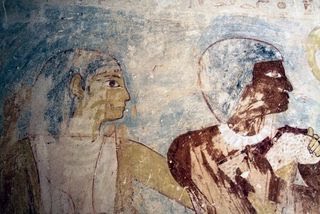
Ancient Egyptian Priest's Tomb Unearthed in Giza


As of this monday, Egypt has anounced that their archaeologists have discovered a more than 4,000 year old tomb near the Giza pyramids. This tomb was for Rudj-Ka a priest that sometime in the fifth dynasty (2465 - 2323 B.C.) He was part of a Cult under the rule of pharaoh Khafre. According the Zahi Hawass, general secretary of Egypt's Supreme Council of Antiquites, The pharaoh pyramids remained intact and well functioning due to the help of a cult of priests like Rudj-Ka and they preformed rituals to honor their dead leaders. The tomb is built of limestone blocks, and is positioned in a cliffside and also shows illustrations of daily life in Egpyt. Hawass believes that this discovery may lead to unknown and larger necropolises are near the great pyramids. He also is speculating if there is more tombs dedicated to some of the members of the royal court such as Rudj-Ka a Priest.


Jesse V. Period 1

Odd Medical Treatments of the 18th and 19th Centuries


It’s hard to imagine having your doctor recommend sulfuric acid as mouthwash, but in the 18th and 19th centuries many other unsafe and unsanitary practices including this were considered protocol (the norm). The U.K.’s national archives has released numerous medical diaries that contain detailed explanations of outlandish and sometimes successful treatments that were kept by royal navy officers. One account entails of a man who was revived with tobacco smoke after being overboard for more than 10 minutes. Rum was a much favored treatment for many things including headaches, spider bites, and scorpion stings. Another common practice – bloodletting was used to “cure” pneumonia. The patient was required to bleed 3.5 pints every three hours which inevitably led to death. One entry details a 12 year old girl vomiting an 87 inch long worm which was no doubt due to the effect of ingesting undercooked meat that came from cattle that were infected with tapeworms. This does not go to say that many of these illnesses could not have been prevented. Drunken brawls and gun fights were the cause of many broken bones and concussions. Another entry discusses the spread of venereal diseases on the HMS Gladiator in which one sailor infected with syphilis encounters a young woman with gonorrhea as an “experiment”. All in all, while these diaries may be appalling, they also provide a more accurate view of the high seas when it was run by the Royal Navy.

Brittany S. Period 1

The Secret of the Mona Lisa's Smile


Their is much more behind the Mona Lisa than we see. Using special x-rays we are able to see many thin layers of paint underneath the top layer of paint on the Mona Lisa. About 40 different layers have been discovered. Da Vinci did this on purpose as his intention was to create a sort of smoky or blurring the outlines of the figure. This is known as "sfumato" from the Italian word "fumo" (meaning smoke). He did this by laying down a thin glaze and smearing it with his finger. This gave the painting a more three dimensional effect. Each one of these layers is about 1-2 micro meters, about 50 times thinner than the human hair.

One of the Mona Lisa biggest mysteries is her smile. It seems as though it glows. Using the same x-ray machine they noticed the sfumato effect in the smile. Using contrasting colors gave the smile a certain glowing effect. This effect took many years to complete. The whole painting took around four years to complete. The sfumato effect is seen all through the painting and gives it a very life like feeling. Using the sfumato effect has given the Mona Lisa her very interesting look and smile.


Nathan D. Period 1

Alexander the Great Killed by Toxic Bacteria


There have been many different theories on how the ruler Alexander the Great may have died at the young age of thirty-two. One theory suggests that he may have been poisoned, and the poison may have come from the deadly Styx River. The Styx River according to myth is the portal to the underworld, the waters lethal enough to ruin crystal, pottery and bronze, and even render a god unable to move or breath for a year. Recently, scientists have found that there may actually be a deadly poison in the river. This “poison” would be calicheamicin, a secondary metabolite of Micromonospora echinospora that is extremely cytotoxic. It was first found in deposits of calcium carbonate that form on limestone. The waters of the Styx come from the mountains of Achaia, Greece and run over a limestone crag where the bacteria could be picked up. The bacteria can cause illness that induces high fever, chills, and severe muscle and neurological pains, which are similar to the symptoms that Alexander faced in his last days. Since the water was said to be deadly enough to strike down a god, and Alexander was considered semi-divine it is possible one saw it the best poison to kill him. Scientists have yet to determine if calicheamicin is definitely the toxic bacteria to plague the Styx River, however, and there is no way to know if it is fact the cause of the once great rulers death.
Emily M. Period 1

One 15 Million Dollar Meal? Preposterous!


Can you imagine spending $15,000,000 on a single meal? Today a cheap dinner can cost only a couple bucks at a fast food joint. But Cleopatra, a pharaoh of ancient Egypt, was once involved in a bet against her lover, Marc Antony, in which she had to spend 10 million sesterces on a single meal, which today is equaled by about 15,000,000 U.S. dollars. Cleopatra accomplished this gigantic feat by an ingenious thought; take a small but valuable object, say, a pearl earring, and consume that, in order to fulfill the enormous budget. As ancient sources so claim, Cleopatra plopped the pearl into a glass of vinegar, most likely white vinegar, and then consumed the drink, and in this way, she beat Marc Antony on their bet. Today, that claim to such an outrageous action is supported by the experiments of Prudence Jones, a classicist of the Montclair State University. Jones placed a large pearl in a glass of white vinegar, similar to what was popular around this period of Greco-Roman culture, and discovered that the pearl would dissolve in about 24 to 36 hours. The process could be sped up by boiling the vinegar or crushing the pearl first. Through Jones’ experimentation and obvious evidence, it appears apparent that Cleopatra really did swallow a pearl and spent 10 million sesterces on one meal. Although this event is considered a falsity or legend by some historians, new support, old records, and the baking by several educated people grants support to the accuracy of such a claim. In the words of a Stanford University research scholar, Adrienne Mayor, ""I think this research has convincingly demonstrated the technique that Cleopatra could have used to dissolve a pearl. We already know that this curious, intelligent queen carried out toxicological experiments." True or false? Would you be able to spend 10 million sesterces in a single sitting without so ingenious a plan? Even with the backing and resources of so influential a pharaoh? It takes a special person to achieve that brilliance.
By Samantha H. Period 3

http://news.discovery.com/history/cleopatra-pearl-cocktail.html

Tuesday, October 19, 2010

Is this Nefertiti?


Archaeologist Joan Fletcher has been working with the mummy for twelve years and still she is not certain if the mummy is Nefertiti or if it isn’t. Fletcher has accumulated new first hand evidence suggesting that this mummy is indeed Nefertiti. Because this mummy is bald it raised some doubts but Fletcher has found a wig discovered in the tomb that was most likely used by Nefertiti. The mummy was probably mutilated and destroyed by grace robbers looking for jewels, but one of the injuries was sustained in life resulting in severe blood loss and probably her death. The mutilations may have also been by priests trying to destroy her chances of going into the afterlife.

JJ A. Period 7

2012 Mayan Calendar ‘Doomsday’ Date Might Be Wrong


It is commonly known that the Mayan’s “predicted” the end of the world on December 21, 2012. Predicted by one of their calendars, they suspect the world to end due to many cataclysmic astronomical events, which we know is completely incorrect. But according to a professor at UC Santa Barbara, the “end day” may be inaccurate by a total of 60 days at least. Historians have also said that the Mayan calendar never predicted an apocalypse. When the Mayans created the “Long Count” calendar, a departure from the shorter calendars, it was a numerically predictable calendar, not based on archaic measures of time. The Mayans predicted that the calendar would run out after 5,126 years. This calendar began in the year 3114 making the “end date” 2012. The date is December 21st due to the day the day the Winter Solstice begins in the Northern Hemisphere. The major issue with this date being inaccurate is the fact that archaeologists might of miscalculated the right day due to the fact that the Mayan calendar didn’t perfectly translate into “our” Gregorian calendar of years, months, and days.

By: Taylor W.
Period: 7

Child Abuse in the Americas?


Compared to the cruel working conditions children suffered during the Industrial Revolution, the Incan sacrifices triumphs over other society’s treatment of children. Just a few months ago, archeologists discovered the remains of seven children sacrificed and buried with gold and silver figurines, pottery, and clothing beneath a 500-600 year old building found in the Cuzco Valley in Peru. Unfortunately, Incan and foreign children between the ages of three and twelve were selected for these sacrificial rituals based on their physical attributes and tooth development. After chosen, victims were brought to the Incan capitol, Cuzco, and escorted to distant sacrificial sites, where religious priests administered elaborate ceremonies and violently strangled and fractured children’s hyoid neck bone to honor the Incan deities and promote political unity. Moreover, it seems the Inca viewed these sacrifices seemed seamless and ordinary to normal Incan society. Nonetheless, due to the evolution of laws and religion, such actions would lead to death, persecution, or other unsympathetic penalties today.

Brandon Y. Period 7

http://news.discovery.com/archaeology/inca-child-sacrifice-clues.html

Monday, October 18, 2010

Ancient Maya Buried Relatives, Artifacts Under Homes


The Ancient Mayan commoners may have been illiterate, but they discovered ways to record their history without writing it down. They did so by burying their life underneath their homes. In Central Belize, an area where Mayan civilizations once were, two houses uncovered about a dozen human remains, along with artifacts, bones, rocks, and other symbols of their daily life. In the Maya, the burials were an important event. When a death has occurred, the house and everything in it is burned down. This provides a base for building a new house, and this process is repeated after major family member’s deaths. Many bowls and art were found in perfect condition, and they were symbolically arranged for the ceremonies. Although we don’t have written material from the Mayans, they have provided us an artistic way to discover and interpret their lifestyles, which still astound us today.


http://news.discovery.com/archaeology/maya-burial-homes-histories.html

by Madi C., period 8

A Babylonian Revival


As of the 30th of September, researchers at Cambridge University have discovered how to speak Babylonian. Through an in depth study of forensic evidence, spelling commonalities, and comparisons with other known languages, the scholars have been able to discover how to pronounce the words of the Babylonians, instead of just reading them. The scholars have posted several audio recordings of themselves speaking these languages online. A sample of these recordings can be found here: http://www.firstcontactradio.com/blog/?p=167273

The commander-in-chief of this massive undertaking was Martin Worthington, who claimed his work to be that of a detective, deriving clues from the cleverest places. He knows their current pronunciations may not be perfect, but he feels as if they have made a fairly good guess. Because of his work, documents such as the Epic of Gilgamesh and the Code of Hammurabi that have not been read aloud in over 2000 years can be heard anew in modern times.
http://sify.com/news/scholars-bring-alive-babylonian-2-000-years-after-it-died-news-international-kj4vaoichib.html

Griffin B. Period 8