Sunday, December 5, 2010

Michelangelo’s David armed?


New research shows that Michelangelo’s David is holding in his right hand, the remains of a weapon. This weapon known as a fustibal is a staff sling that has a leather strap attached to the end. The study which concluded that the statue is indeed holding a weapon was presented at “Florens 2010: The International Week of Cultural and Environmental Heritage.” This staff-sling weapon was used to throw stones corresponding with David’s role as a biblical hero. In the bible, the story says that he “took up his shepherd’s staff, five smooth stones, and his sling.” The sling is the only of these things represented in the statue. With his left hand, he holds the pouch of the sling above his shoulder. The straps appear to be attached to an unknown item, now speculated to be the handle that the staff would be mounted on, creating the weapon. However, it is believed that the staff was not mounted because the place of display for the statue was changed, and the shepherd staff did not go with the new political meaning of the statue. In its expected display location, atop the Cathedral, the weapon would have remained concealed, with people only seeing the pouch and staff. But, placed in the doorway of the Piazza Signoria on September 8, 1504, it was transformed into a symbol of republican freedom. This study is highly controversial, and other scholars are skeptical. Among the other theories, is the idea that David is holding the handle of the sling, rather than a staff-sling, or Fustibal. 500 years later, Michelangelo’s David is still mysterious and open to new interpretations.

http://news.discovery.com/history/michelangelo-david-secret-weapon.html#view-comments


Jaclyn D Period 7

King Tut: Death by Hippo?


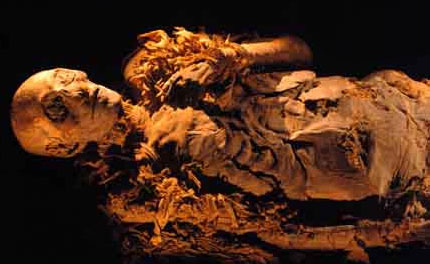
Throughout the years, scientists have been completely puzzled by the exact death of King Tut. Many researchers have provided different theories as to why and what killed King Tut such as a coup de e'tat, gangrene, or a genetic disorder that took him at an early age. However, Egytology professor, Dr. Benson Harer, has laid out another theory on the table: a hippo death. Dr. Harer, concludes that King Tut was inflicted by a lethal hippo bite. Evidence of severed ribs, and his missing chest cavity and heart tipped off Harer. Usually, leaders as prestigious as King Tut would have his heart and chest inside of him during the embalming process which followed the strict mummification code, but Tut did not. Dr. Benson even says that King Tut's priests did not tell the public of his actual death to not let the people lose faith in the hierarchy. The Hippo was a praised deity and portrayed gods and goddesses from above. This type of "death by hippo" would force the people to think that the King was unfit for the throne and the gods despised him, leading to a panicked society.
Although Benson's idea maybe completely outrageous, death by hippos in Africa today are seen everywhere. Hunting for hippos was a highly accepted hunt for King Tut as well as people today which is why it may not seem like such an anomally for King Tut to have been killed by a hippo.
Michelle T Period 7

Lost But Now Found: the Body of Queen Hapshepsut


Queen Hatshepsut is known as one of the first, most powerful women in world history. Her reign in Egypt was one of prosperity portraying her great leadership, yet, after her death, her history was nearly erased from Egypt. Records were destroyed, monuments desecrated, and her body was stolen from her tomb. It is believed that such extensive actions were taken to eradicate the information because of the fact that she was a female in a man's position. The body has been missing untill recently when a team of scientists created a scan of her physical features and compared it to thousands of unidentified corpses. After narrowing down multiple times, they came down to two mumies but after comparing a missing tooth, they finally found the missing queen.

A New Female Pharaoh for Ancient Egypt


Cleopatra VII was the only female pharaoh of the Ptolemaic dynasty, but due to recent analysis of the royal crown, Queen Arsinoe II held that distinction 200 years earlier.
Born in 316 B.C. to Ptolemy I, friend of Alexander the Great, Arsinoe married her half brother Ptolemy Keraunos, after the death of her first husband, Lysimachus of Thrace. That marriage quickly ended after he killed two out of their three children in a power struggle, she returned to Egypt and married her full brother Ptolemy II. They became co rulers of the empire.
Anthropologists play close attention to her crown for crowns often served as an indicator for their role in society. Arsinoe’s crown reflected she was a high priestess, co-ruler, and religious significance as the goddess Thea Philadelphus. Most importantly, it showed she ruled as an equal and co- ruler to her brother. When Arsinoe died in 270 B.C. at 45, she became the first Ptolemaic Queen to receive her own cult and was worshipped for years.
http://www.history.com/topics/new-female-pharaoh
Shannon R. Period 8

Saturday, December 4, 2010

Roman Pools


Who knew that the Roman's had swimming pools? Well, at a recently discovered site in Jerusalem, archaeologists discovered the remains of several pools and baths that were once indoor structures of some sort of bath house. The discovered terra cotta roof tiles indicate that this was a large indoor structure. Some of these tiles were marked “LEG X FR,” for the tenth legion, "Fretensis". These pools are said to have been used by the Roman soldiers after taking Jerusalem and removing the Jews from their city. One of the plastered pools contains the footprint of a dog, possibly belonging to a soldier. This vast bath house reveals the extreme size of the Roman city in Jerusalem, founded by Emperor Hadrian. It shows the extent of artistry and technique used to make returning soldiers comforted and relaxed, which also shows the leisurely culture of the Romans.
Controversy of whether or not these water holding structures were pools or simply baths arose, however, the differing sizes and depths of them may show them to be used for several different purposes; possibly even a leisurely swim.

Headless Roman Skeletons Discovered in English Cemetery


80 exotic, beheaded skeletons were recently unearthed in an ancient English cemetery, and according to archaeologists, “the victims lost their heads a long way from home.” Of these 80 skeletons, almost all were male, and the majority were either buried with no head or buried next to their decapitated skull. Archaeologists have now discovered that these ancient burial grounds were used by the Romans in the 2nd and 3rd centuries, A.D. According to one U.K. archaeologist, these skeletons are quite different physically from the people of ancient York, then called Eboracum. Using isotope science, the archaeologists were able to discover that, out of eighteen of these skeletons that were tested on, only five were originally from York, and the other thirteen had diets including plants that were not cultivated in England at the time. Several theories have developed as to why these exotic skeletons were in Rome at the time. One study shows that they may have been soldiers of a distant land, slain by Roman soldiers at the garrison in York. Another suggests that they may have been imported gladiators, and tooth marks from a large carnivore on one skeleton may have been from a gladiatorial lion or bear. Whatever the answer may be, it will require further forensic studies and bone analysis, and maybe then the truth of these exotic skeletons will be revealed.

http://news.nationalgeographic.com/news/2010/10/101028-headless-skeletons-ancient-romans-england-exotic-science/

Hunter S Period 7

Lost Nazi-Era Art Resurfaces in Berlin Cellar


While digging for 13th century remains of a town house, archeologists were surprised to find the head of a terracotta statue. The archeologists found eleven terracotta statues overall dating back to the early 20th century. These statues and other works of art were outlawed by the Nazis who took them from German art museums and claimed them to be “degenerate art.” The terracotta statues and other artwork were put on display in Munich by the Nazis. These pieces of art and many others were also outlawed. Upon discovering them, eight of the eleven statue’s artists have been identified. Continuing investigations of the town house’s cellar, which was destroyed by bombing, revealed the artifacts which all contain burn marks. Specialists were able to identify these artifacts from old photographs. The photographs showed many of the objects the Nazis stole from over one hundred German museums to put on display in Munich. The works of art displayed in these photographs were believed to have been sold for a profit or they could have been stolen or destroyed during World War II. Specialists, also, believe that the eleven terracotta statues were possibly saved by Erhard Oewerdieck, a tax collector who helped save some of the Jewish people during World War II. It is interesting to learn that the cellar that contained these eleven terracotta statues was part of the bombed town house that contained Erhard Oewerdieck’s office.

http://news.discovery.com/history/nazi-art-sculptures-berlin.html

Eveline G Period 7

Saturday, October 30, 2010

Mystery of Inca Gold


Throughout history, there are unsolved mysteries that civilizations leaved behind causing to unravel them. One legend is called the gold from Inca civilization is missing after the Spaniard conqueror, Francisco Pizzaro, denied the deal that Atahualpa offered him. The deal was when Pizzaro captured him, Atahualpa would give him a gold filled room. Now, the largest part that was supposed to be delivered never reached Pizarro and its hidden somewhere in a secret mountain cave. However, Valverde went treasure hunting which was led by his bride causing him to be rich. Before he passed away, he left directions on finding the gold called Derrotero de Valverde. Although, the gold treasure hunting began to die off in the 1850’s. A treasure hunter, Barth Blake, went to venture off to find the gold hidden by the Incas. He successfully found the gold and he wrote “There are thousands of gold and silver pieces of Inca and pre-Inca handicraft, the most beautiful
goldsmith works you are not able to imagine” in his letter. Though fate did not take him kindly because on his way back, he disappeared. According to Mark Honigsbaum, the gold will never be found due to it may have been already taken or it is lost in the mountains.
http://www.nationalgeographic.com/guides/history/ancient/lost-inca-gold.html
Aspen F., Period 8

Tuesday, October 26, 2010

Mona Lisa’s Smile Hides Da Vinci’s Technique


Hidden behind the Mona Lisa’s enigmatic Smile are dozens and dozens of layers of ultra-thin glaze, according to French researchers who examined the masterpiece through non-invasive x-ray fluorescence spectroscopy. The investigation revealed that up to 40 layers of transparent glaze, possibly smeared on with his fingers, produce the unique effect behind the mysterious smile. He used layers that were 1-2 micrometers thick, about 50 times thinner than a human hair. And since the layers were uneven, it created an illusion of a smoky effect around her mouth. This made it look more realistic and original because it makes it look like light and shade are blended without borders, creating a smoky effect. This effect is called, “Sfumato”, from the Latin base fumato meaning, “Smoke or fume.” The technique involved letting the layers dry for long periods of time, which could last from weeks to months. Attempts to solve the enigma around her smile, as proclaimed by 16th century artists, included theories from she was a noblewoman who was happily pregnant, suffering from asthma, had facial paralysis, or that the smile was a result of compulsive gnashing of teeth.


Weather Wars


A daring new study claims that the unraveling and creation of ancient Chinese dynasties has more to do with climate changes than political or social defects. The theory that weather disasters like floods and drought triggered shifts of power between dynasties are not new, however, until recently, no one had closely examined the intertwined relationship of changes in climate and Chinese society. Scientists led by Zhibin Zhang compared climate patterns of ancient times with the history of Chinese dynasties. They discovered that the collapse of agricultural reliant dynasties such as the Han, the Tang, both the Northern and Southern Song, and the Ming are closely linked to low temperatures. They also found that prosperous and stable periods occurred during warm spells.


Melanie Mabry Period 3